Masjid Al-Modhoun (Al-Qantara Mosque) Taif Ziyarat Guide
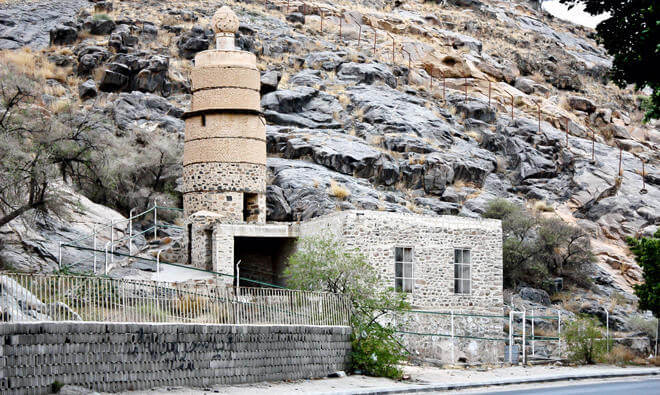
Masjid Al-Modhoun — also known as Al-Qantara Mosque or Qabil Mosque — is a historic Ottoman-era mosque in the Al-Mathnah neighborhood of Taif, about 70 km from Makkah. It’s known for its unusual twisted, cylindrical minaret and for standing opposite a farm traditionally linked to the Prophet Muhammad’s ﷺ journey to Taif. The mosque itself is largely inactive today, but it remains a popular short stop for pilgrims and visitors touring Taif’s historical sites.
If you’re planning a Taif ziyarat trip from Makkah and want to know exactly what this mosque is, why it matters, and how to reach it, here’s what’s actually known.
Where Is Masjid Al-Modhoun Located in Taif?
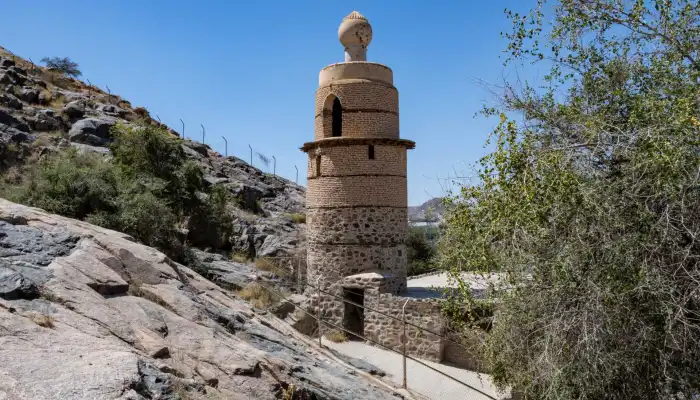
Masjid Al-Modhoun stands at the foot of Mount al-Madhoon, in the Al-Mathnah neighborhood of Taif. Taif itself sits in the Makkah al-Mukarramah Province, roughly 70 km from Makkah, in the highlands of the Hejaz region. Because of this relatively short distance, many travelers visit as a day trip from Makkah rather than staying overnight in Taif specifically for this site.
The mosque is close to another historical site, Al-Qu’a Mosque, and both are commonly visited together as part of the same stop in Al-Mathnah.
The History Behind Al-Qantara Mosque
According to a licensed Saudi Commission for Tourism and National Heritage guide cited by Arab News, the mosque was built roughly 162 years ago, during the Ottoman era. Its design, however, draws on much older Abbasid-era architecture — similar in style to the twisted minarets seen at the Great Mosque of Samarra and the Ahmad ibn Tulun Mosque in Egypt — which is why the building can look considerably older than it actually is.
The Twisted Minaret
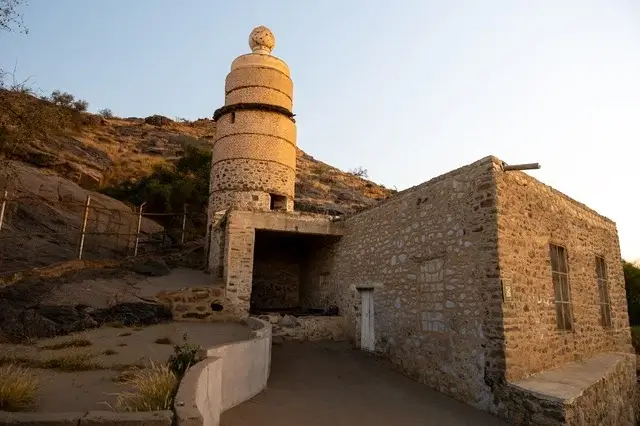
The mosque’s most distinctive feature is its minaret: a folded, cylindrical column that tapers upward into a rounded, spherical peak, quite unlike the straight minarets found on most mosques in the region. Some visitor accounts describe being able to climb the minaret’s internal staircase for a view over the surrounding fields, hills, and farmland, though access has varied over time and shouldn’t be assumed as guaranteed on any given visit.
The mosque also has a rectangular, hollow lower section and a roofline that projects outward from the walls, angled to drain rainwater — a practical architectural detail as much as a decorative one.
The Story Visitors Come to See
The Garden Opposite the Mosque
Most visitors aren’t drawn to Masjid Al-Modhoun purely for its architecture. Opposite the mosque is a farm or garden that local tradition connects to one of the most well-known episodes in the Prophet Muhammad’s ﷺ life: his journey to Taif to invite its people to Islam, and the difficult reception he faced there. Tradition holds that after leaving the city, the Prophet ﷺ rested in this garden, where he was offered grapes by a farmer named Addas — who, moved by what he witnessed, is said to have accepted Islam.
This is the reason the mosque appears on so many Hajj and Umrah pilgrims’ Taif itineraries: it sits near a site associated with a formative moment in early Islamic history, not simply because of the building itself.
Separating Verified History from Local Folklore
It’s worth being clear-eyed here, because not every story attached to the site carries the same weight. Some local accounts describe a stone at the site said to bear the imprint of the Prophet’s ﷺ elbow. Historians who study the area have generally rejected this specific claim as folklore rather than verified history. If you visit, you’ll likely hear a mix of both — the broader, well-documented account of the journey to Taif, and smaller, unverified local stories layered on top of it over time. Treat the latter as local tradition, not established fact.
For anything related to religious rulings, historical authenticity, or the significance of specific sites, it’s best to rely on official Saudi heritage authorities or recognized Islamic scholarship rather than informal accounts picked up during a visit.
What to Expect When You Visit Today
By most current accounts, the mosque itself is not in active use for daily prayers — it’s typically described as locked or largely inactive, valued today as a heritage site rather than a functioning place of worship. Its walls and minaret show the wear you’d expect from a structure that’s over a century and a half old. This means a visit to Masjid Al-Modhoun is best approached as a short historical stop — worth 15–30 minutes to see the building, the minaret, and the garden across from it — rather than a full destination in itself.
Visiting Masjid Al-Modhoun Alongside Al-Qu’a Mosque
Because Al-Qu’a Mosque sits close by in the same Al-Mathnah neighborhood, many travelers combine both stops in a single visit. If Taif’s historical sites are the main purpose of your trip, it’s worth planning your route in Al-Mathnah so you can see both mosques without doubling back — something easier to arrange with flexible, private transportation than with a fixed-schedule option.
How to Travel from Makkah to Masjid Al-Modhoun in Taif
Since Masjid Al-Modhoun is located inside Taif rather than directly on the main Makkah–Taif highway, most visitors need transportation that can take them from their Makkah hotel into Taif itself, and then to the specific Al-Mathnah neighborhood — something a fixed-route bus service typically isn’t set up to do.
Travelers who want a direct, door-to-door journey — from their Makkah hotel to Masjid Al-Modhoun, with the flexibility to also stop at Al-Qu’a Mosque or other Taif attractions along the way — can arrange private transportation from Makkah to Taif Taxi. This kind of trip suits families, small groups, and pilgrims who’d rather set their own pace than follow a fixed tour schedule.
If this fits your plans, you can contact Makkah to Taif Taxi on WhatsApp at +966 57 4915 372 to ask about availability, pickup arrangements from your Makkah hotel, and routing that includes Al-Mathnah’s historical mosques as part of your Taif trip.
Conclusion
Masjid Al-Modhoun is a small but historically layered stop: an Ottoman-era mosque built in an older architectural style, standing beside a site tied to one of the most significant journeys in early Islamic history. It rewards a short, well-informed visit more than a rushed one — knowing what’s verified history and what’s local tradition makes the stop more meaningful. For travelers coming from Makkah, reaching Al-Mathnah comfortably and combining it with nearby Al-Qu’a Mosque is easiest with private transportation. Makkah to Taif Taxi can arrange a direct hotel-to-mosque journey — reach out on WhatsApp at +966 57 4915 372 to plan your route.
FAQs
Where exactly is Masjid Al-Modhoun located?
It’s in the Al-Mathnah neighborhood of Taif, at the foot of Mount al-Madhoon, roughly 70 km from Makkah.
Is Masjid Al-Modhoun the same as Al-Qantara Mosque?
Yes. Al-Modhoun (also spelled Al-Madhoun/Al-Madhoon) and Al-Qantara are names for the same mosque; it’s also sometimes referred to as Qabil Mosque.
Can I pray inside the mosque?
Most current accounts describe the mosque as inactive and generally locked, so it’s best visited as a heritage site rather than for daily prayer. Conditions can change, so it’s worth checking locally if this matters to your visit.
Is the story about the Prophet’s ﷺ elbow imprint on a stone true?
This specific detail is treated by historians as local folklore rather than verified history. The broader account of the Prophet ﷺ resting in a garden near this site during his journey to Taif is the part that’s well documented; the elbow-imprint story is a separate, unverified local tradition.
How do I get from Makkah to Masjid Al-Modhoun?
Since the mosque is inside Taif’s Al-Mathnah neighborhood rather than on the main highway, a private taxi or car from Makkah is generally the most direct way to reach it, especially if you also want to stop at nearby Al-Qu’a Mosque.